“I knew immediately what had happened because I couldn’t feel a thing,” Rahalkar says, recalling the moment his life changed forever. He also feared everything he’d been working for was gone.
A team of off-duty first responders came upon the crash. They got him out of the car and to a local hospital, where X-rays showed a cervical spine fracture and spinal cord injury. An air ambulance rushed him to Halifax.
He spent four weeks in a spinal injury ward and six months in rehabilitation. His recovery was grueling, yet faster than expected—a testament to his determination and drive.
But there were more challenges ahead.
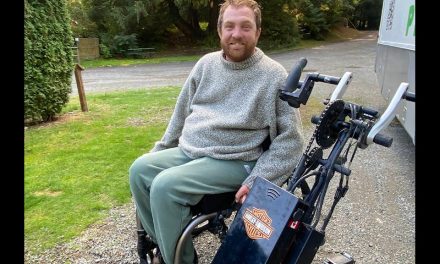
His apartment, with thresholds and stairs, was no longer suitable. He needed a new place to accommodate his motorized wheelchair and a special van.
“From there, it took another seven or eight months to figure out how I was going to go back to work.”
He met some resistance reframing his approach. Some suggested he switch to another specialty. But Rahalkar remained resolute in his desire to practice endocrinology—an interest he developed through a research internship during his early years in medical school at Western.
“I couldn’t see myself doing anything else.”
Three years after the accident, Rahalkar completed his fellowship. He did so with the support of his parents, and partner Jeff MacPherson. At the time of the accident, MacPherson and Rahalkar had been dating for eight months.
MacPherson was in the car the night of the accident and has been by Rahalkar’s side since—as his primary caregiver, and, having proposed just two months after Rahalkar left intensive care, his husband. He’s also Rahalkar’s most fierce advocate.
“While I focused on getting better, Jeff fought the powers that be, so I could get back to work,” Rahalkar says. “He was the ‘bulldozer’ who cleared away a lot of the obstacles.”
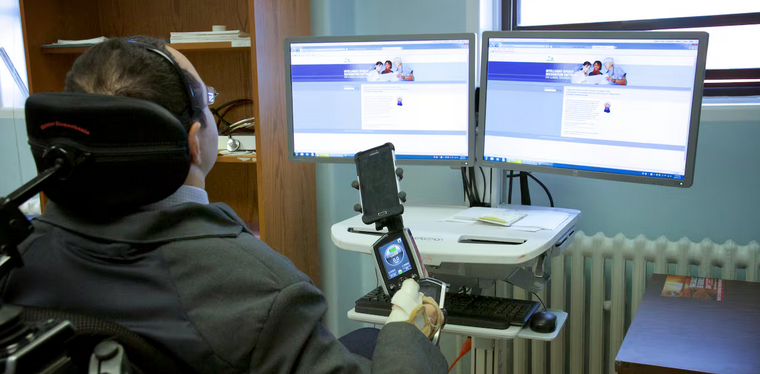
One of MacPherson’s easier tasks was contacting the publisher of Rahalkar’s heavy endocrinology textbook, requesting a digital copy he could access independently. It took more work negotiating the supports Rahalkar needed to finish his fellowship: voice dictation software and a nurse to “act as his hands,” taking notes and conducting physical exams.
“It took a lot longer than it should have… but I did finish it,” he said, noting the two-year placement wound up taking five.
Rahalkar employs the same supports today, operating his endocrinology clinic in his hometown of Sarnia, Ont. He provides a much-needed service, treating patients with Type 1 and gestational diabetes, thyroid problems and gender dysphoria.
“Endocrinologists don’t do very many procedures. In fact, these days they don’t really do any at all,” he said, noting most of the work is ordering tests and procedures and interpreting results. “In many other specialities I would not have been able to continue.”
Endocrinology is a branch of medicine that deals with glands and hormones. Most of his patients are diabetic, have osteoporosis or thyroid problems, or are undergoing hormonal therapy for gender dysphoria, he explained.
Just a handful of the endocrinologists are certified in Canada each year, he noted, and most set up shop in the Toronto area.
The patient wait list to see him is currently about one month.
Ten years into his remarkable journey of resilience, Rahalkar’s not one to tout personal triumphs. He’d rather bring awareness to the barriers people with disabilities face. Curbs, steps and narrow entrances. Limited transit and travel options. “Even something as simple as leaving your house or apartment is not easy and it should be attainable.”
MacPherson agrees. “It’s heartbreaking to see the guy who would climb hillsides and hike being limited to only what’s accessible. We’ve gone from ‘go, go, go,’ to having to plan things now.”
Rahalkar’s grateful for the resources that allowed him to customize his home and office with ramps, wide doorways and other modifications, but asks, “What if you don’t have the money?”
He’s as practical as he is passionate in his desire to see a more inclusive society.
“As the population ages, there will be more customers, more clients, more patients who need to be accommodated somehow, whether by making things physically barrier-free, or having spaces accepting of people with autism or visual or hearing impairment.
“It shouldn’t be this hard for someone in my situation to work and to contribute. And there are lots of people like me who would love to contribute. How do you do that if the world isn’t built to accommodate you? It shouldn’t take a bulldozer to get it done.”